
YOUR COMPRESSOR
IS MAKING AIR.
BUT WHERE IS IT GOING?
Compressed air leaks waste energy, reduce available capacity and can make a healthy compressor system look undersized.
The Wright Air Guide

Find The Leaks

Stop The Waste

Keep The Air

How Much Are Compressed Air Leaks Costing Your Business?
The Complete Guide to Finding, Calculating and Preventing Compressed-Air Leaks
Compressed air is valuable because it is expensive to produce. Electricity is converted into compressed air, conditioned, stored and distributed through the plant. When that air escapes through a failed coupling, worn hose, open drain or loose fitting, the energy used to produce it disappears with it.
That is why leakage is not simply a maintenance nuisance. It is an energy, capacity, reliability and operating-cost problem.
THE CORE PRINCIPLE
The most expensive compressed air is the air you pay to produce and never use.
Wright Air has repeatedly highlighted that leaks can quietly consume meaningful compressor output. Higher working pressure can also increase leakage. The opportunity is therefore not merely to find obvious hissing connections, but to manage leakage as a measurable part of the compressed-air system.
This guide explains where leaks occur, how they affect compressor loading and pressure, how to estimate their cost, how ultrasonic leak detection works, and how to build a repeatable leak-management programme.
Contents
01 Why compressed-air leaks are so expensive
02 Where compressed-air leaks usually occur
03 How a small leak becomes a serious cost
04 How to calculate the cost of a compressed-air leak
05 Why higher pressure makes leakage worse
06 Leaks can create a false capacity problem
07 How ultrasonic leak detection works
08 The professional leak-survey workflow
09 Prioritise repairs by value – not just by count
10 Why fixing leaks once is not enough
11 A practical leak-management programme
12 Frequently asked questions
1. Why Compressed-Air Leaks Are So Expensive
A leak wastes more than air. The compressor has already consumed electrical energy to draw in atmospheric air, compress it and deliver it into the system. If that compressed air escapes before doing useful work, the electricity has still been consumed but no productive value has been created.
Leakage also changes how the compressor plant behaves. The compressor may load more often, remain loaded for longer, or bring an additional machine online to maintain header pressure. This can increase operating hours, maintenance demand and electricity consumption.
In a plant with adequate reserve capacity, production may continue normally even while significant leakage exists. That is precisely why leaks can remain hidden: the compressor compensates for them.
- Higher electricity consumption – compressors work to replace lost air.
- Longer loaded hours – the system has to generate more air than production actually needs.
- Reduced available capacity – part of the compressor’s output is consumed by waste.
- Pressure instability – leakage can contribute to pressure decay, especially at peak demand.
- Additional maintenance – unnecessary running adds operating hours to the compressor plant.
A useful way to think about leakage
If a plant requires 4.0 m³/min for productive work but the compressor room must supply 5.0 m³/min to maintain production, the missing 1.0 m³/min has to be explained. It may include legitimate intermittent demand, but it can also include leakage, open blowing and other non-productive uses. Until the system is measured, buying more compressor capacity may simply increase the amount of air available to waste.
2. Where Compressed-Air Leaks Usually Occur
Leaks can occur anywhere between the compressor room and the final point of use. A complete survey therefore needs to follow the entire system rather than stopping at the compressor.
- Quick couplings and push-in fittings
- Flexible hoses and hose tails
- Pipe joints, tees, reducers and branch connections
- Manual isolation valves and worn valve seals
- Filter-regulator-lubricator assemblies
- Condensate drains that fail open or purge excessively
- Pneumatic cylinders, actuators and valve manifolds
- Air receivers, gauges and pressure-switch connections
- Unused drops and redundant pipe branches that remain pressurised
- Production equipment with worn internal seals
Why leaks multiply over time
Compressed-air networks live in a demanding environment. Vibration, thermal cycling, repeated hose movement, maintenance work, corrosion, ageing seals and modifications to production lines all create new opportunities for leakage. A system that was tight after commissioning will not necessarily remain tight indefinitely.
This is why leak detection should be treated as a maintenance programme, not a once-off clean-up exercise.
3. How a Small Leak Becomes a Serious Cost
Leakage through an opening increases with hole size and is influenced by system pressure. A seemingly minor defect can therefore become a surprisingly large continuous air consumer when the network remains pressurised for long hours.
Published industry reference values illustrate how rapidly losses can grow. At around 7 bar(e), approximate leakage can rise from roughly 1.2 l/s through a 1 mm opening to about 124 l/s through a 10 mm opening. These figures are illustrative and do not replace measurement of the actual plant.
|
Illustrative hole size |
Approx. leakage at 7 bar(e) |
Approx. power associated |
|
1 mm |
1.2 l/s |
0.4 kW |
|
3 mm |
11.1 l/s |
4.0 kW |
|
5 mm |
31 l/s |
10.8 kW |
|
10 mm |
124 l/s |
43 kW |
The financial consequence depends on actual compressor specific energy, operating pressure, hours pressurised and electricity tariff. Leak surveys should therefore quantify or estimate individual leak flow wherever practical rather than merely counting leaks.
4. How to Calculate the Cost of a Compressed-Air Leak
A practical leak-cost estimate links the wasted airflow to the energy required to produce that air.
CALCULATION
Estimated annual leak cost = leak flow × specific energy × annual pressurised hours × electricity tariff.
The units must be consistent. If leak flow is measured in m³/min, convert it to m³/h before multiplying by specific energy in kWh/m³.
Example: assume a group of leaks wastes 0.50 m³/min. That equals 30 m³/h. If the compressor system requires 0.11 kWh to produce one cubic metre of compressed air, the plant remains pressurised for 6,000 hours per year, and electricity costs R2.50/kWh:
|
Step |
Calculation |
Result |
|
Leak volume per hour |
0.50 m³/min × 60 |
30 m³/h |
|
Annual leaked volume |
30 × 6,000 |
180,000 m³/year |
|
Electricity used |
180,000 × 0.11 |
19,800 kWh/year |
|
Estimated cost |
19,800 × R2.50 |
R49,500/year |
Important: this is an illustrative calculation, not a quoted saving. Actual specific energy and tariffs must be measured or verified for the site. A proper audit should use the plant’s real compressor performance, pressure and operating profile.
5. Why Higher Pressure Makes Leakage Worse
Higher system pressure can increase leakage and also increases the work required to produce compressed air. This creates a particularly expensive combination when operators raise compressor pressure to compensate for losses elsewhere in the system.
Industry guidance notes that leakage is proportional to working pressure. A commonly cited example shows that a modest pressure reduction can reduce leakage under otherwise comparable conditions. The exact effect depends on the real system.
The wrong cycle
- Pressure falls at production equipment.
- The compressor setpoint is increased.
- The compressor consumes more energy.
- Leakage and unregulated consumption can increase.
- The plant needs still more compressed air.
- The underlying restriction or leak remains.
Fix the losses, not just the pressure number. Check leakage, filter differential pressure, dryer restriction, pipe sizing and local restrictions before permanently increasing system pressure.
6. Leaks Can Create a False Capacity Problem
A plant may conclude that its compressor is too small because the machine runs continuously or a second compressor starts during production. But if a meaningful percentage of total output is escaping through leaks, the apparent capacity shortage may be partly artificial.
Industrial case studies have shown that repairing priority leaks can reduce compressor utilisation and, in some installations, allow fewer compressors to satisfy the same productive demand. The exact savings from another site should never be assumed for your plant, but the operating principle is important: leak repair can release existing capacity.
BEFORE YOU BUY ANOTHER COMPRESSOR
Measure productive demand. Quantify leakage. Repair avoidable losses. Then reassess whether additional capacity is genuinely required.
This can prevent a business from spending capital on a larger compressor that simply feeds an inefficient network.
7. How Ultrasonic Leak Detection Works
Large leaks can sometimes be heard as a hiss, especially during quiet periods. Soap solution can also confirm a suspected leak at a specific joint. Both methods are useful, but they become inefficient across a large, noisy industrial facility.
When compressed gas escapes through a small opening it creates turbulent flow and high-frequency acoustic energy. Ultrasonic leak-detection equipment is designed to detect that high-frequency signal and help the technician locate the source, even when ordinary factory noise makes the leak difficult to hear.
Modern surveys can often be performed while production remains operational, which is useful because the network can be inspected under realistic pressure and load conditions.
- Audible inspection – useful for obvious leaks during quiet periods.
- Soap solution – good for confirming a suspected fitting or connection.
- Ultrasonic detection – practical for large networks and noisy production areas.
- Flow and pressure logging – helps quantify the overall system effect, not just individual leak points.
The leak you cannot hear may still be costing you money
A good survey is not simply a technician walking around with a detector. The value comes from turning each finding into an actionable record: location, estimated severity, repair priority and verification status.
8. The Professional Leak-Survey Workflow
A disciplined leak-management process converts a collection of hissing fittings into a measurable maintenance programme.
| 1 | DETECT | Survey the full network under normal operating pressure. |
| 2 | TAG | Give every leak a unique identifier and physical location. |
| 3 | QUANTIFY | Estimate or measure leakage flow and annual cost where practical. |
| 4 | PRIORITISE | Repair the highest-value or operationally critical leaks first. |
| 5 | REPAIR | Replace seals, hoses, fittings, valves or failed components. |
| 6 | VERIFY | Recheck the repaired point under pressure. |
| 7 | MONITOR | Repeat the survey and track leakage as a plant KPI. |
The verification step matters. A leak should not be marked ‘closed’ simply because maintenance work was performed. It should be rechecked under pressure to confirm that the loss has actually been eliminated.
9. Prioritise Repairs by Value – Not Just by Count
A survey may identify dozens or hundreds of leak points. Treating every leak as equally urgent can overwhelm a maintenance team and delay the repairs that matter most.
Prioritisation should consider estimated airflow loss, annual pressurised hours, system pressure, electricity cost, repair complexity and production criticality.
|
Priority |
Typical approach |
|
A – Critical |
Large loss, safety/reliability issue, failed drain, major hose or connection. Repair urgently. |
|
B – High value |
Meaningful continuous loss with straightforward repair. Schedule quickly. |
|
C – Routine |
Smaller leak with low operational consequence. Include in planned maintenance. |
|
D – Monitor |
Very small or inaccessible point where repair requires shutdown. Track and combine with planned work. |
This approach turns leak detection into a financial decision-making tool rather than a simple defect list.
10. Why Fixing Leaks Once Is Not Enough
Leaks return. Hoses age, couplings are disconnected and reconnected, production lines move, seals wear and vibration loosens fittings. A one-time leak campaign can produce a short-term improvement, but without follow-up the system can gradually drift back toward its previous condition.
The most effective programmes establish a baseline, complete repairs, verify the improvement and repeat surveys at a frequency appropriate to the site.
- Track total leak count and estimated leak flow.
- Track the percentage of identified leaks repaired.
- Record the time between detection and repair.
- Trend compressor-room flow during non-production periods where practical.
- Compare system pressure and compressor loading before and after major repair campaigns.
- Include leak checks when production lines are modified or new equipment is installed.
A useful maintenance KPI
Do not only ask, ‘How many leaks did we find?’ Ask, ‘How much air did we recover, how much capacity did we release, and did compressor energy or loading improve afterwards?’
11. A Practical Leak-Management Programme
For most industrial sites, the following sequence provides a practical starting point.
- Establish normal compressor-room pressure, flow and operating hours.
- Identify non-production periods that can help reveal baseline leakage.
- Survey the entire network, not only the compressor room.
- Tag and document every confirmed leak.
- Estimate the cost or severity of each leak.
- Repair high-value leaks first.
- Verify every completed repair under pressure.
- Recheck compressor loading and system pressure.
- Reduce unnecessary set pressure where the repaired system allows it.
- Repeat the survey periodically and after major plant modifications.
- Keep a leak register so recurring problem areas become visible.
- Use the findings to inform future compressor sizing and system upgrades.
Wright Air: Diagnose the System Before Adding Capacity
Wright Air’s broader compressed-air approach includes leak detection, system assessment and efficiency optimisation. That matters because a leak rarely exists in isolation. Leakage interacts with pressure settings, compressor controls, storage, dryers, filters and pipework. The strongest result comes from understanding the complete system.
12. Frequently Asked Questions
Common indicators include compressors loading when production is idle, unusually high non-production airflow, declining pressure after shutdown, increasing running hours and audible leaks. Measurement is more reliable than symptoms alone.
Large leaks may be audible, but industrial background noise can hide smaller leaks. Ultrasonic detection is generally more effective for systematic surveys.
Yes. Leakage is influenced by system pressure, and higher pressure also requires more compressor work. This is one reason pressure should not be increased unnecessarily.
Yes. If a meaningful part of compressor output is being lost, the remaining productive capacity may appear inadequate even when the installed compressor could otherwise satisfy demand.
Not necessarily. Ultrasonic surveys can be performed during normal operation. Some baseline leakage tests are also useful during non-production periods.
There is no single interval for every plant. High-use, ageing or frequently modified networks may justify more frequent surveys. The key is to make leak management recurring rather than one-off.
Prioritise leaks by estimated air loss, operating hours, cost, ease of repair and operational consequence. Large continuous leaks and failed drains often deserve early attention.
Find the Waste Before You Buy More Air
Compressed-air leakage is easy to ignore because it is invisible and the compressor often compensates for it. Production continues, but the compressor plant works harder in the background.
The result can be higher electricity consumption, longer operating hours, reduced reserve capacity and pressure problems that appear elsewhere in the factory.
The solution is systematic:
- Detect the leaks.
- Quantify the loss.
- Prioritise the repairs.
- Verify the result.
- Monitor the system.
- Then decide whether additional capacity is actually required.
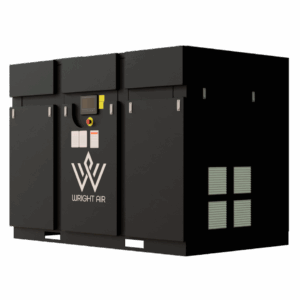
Two Stage Screw Compressors

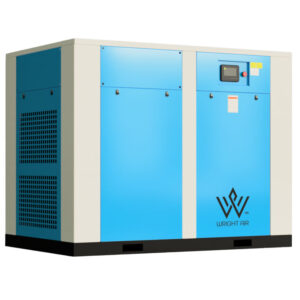
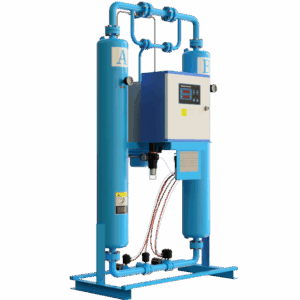

Desiccant Dryer
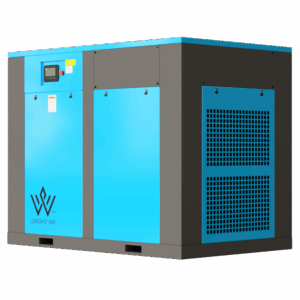
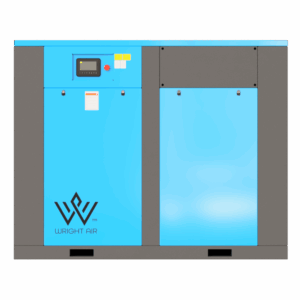
Screw Compressors
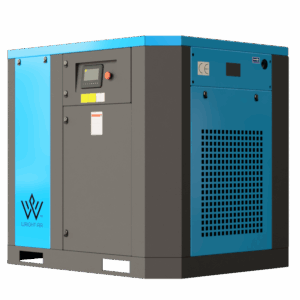

Screw Compressors
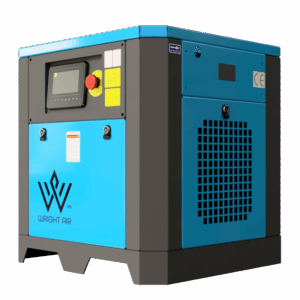

Screw Compressors

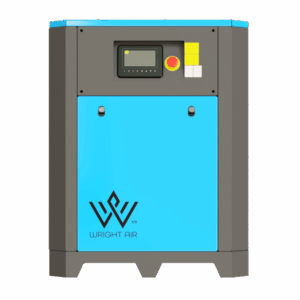
Screw Compressors